What the 2024 rough-in rule put in your house
For houses and other small residential buildings (Part 9 of the code) with a building permit applied for on or after March 8, 2024, the BC Building Code requires a radon rough-in everywhere in the province. Before that, only listed regions required one (The Tyee). A rough-in is the passive half of a radon system: a gas-permeable layer under the slab, such as 100 mm of clean gravel, a sealed air barrier over it, and a 100 mm vent pipe from that layer to the outside, ready for a fan (BC bulletin B24-03).
Here is what a compliant rough-in looks like in the basement:
- A pipe labelled as a radon pipe at least every 1.8 m and at each change of direction, ideally a different colour from other plumbing.
- Clear space around one section for a fan: 1.2 m high and 500 mm across.
- Ideally an electrical box or outlet within 1.8 m of that spot.
- A pipe that ends outside, through the roof or a wall, not a capped stub in the basement.
The capped-pipe mix-up
That last point trips people up. A figure in the notes to the 2024 BC code shows a capped pipe, but the province's bulletin says it was printed in error and the pipe must extend to the exterior. Ontario's rules do allow a capped rough-in, so guides written for Ontario homes describe something different.
Builders do not always get it right. An installer quoted by The Tyee in January 2026 says he often finds homes that should have rough-ins without them, and rough-ins that were built wrong. If your pipe stops in the basement, tell us when you send your details.
Do I need a fan on my radon rough-in?
Only if a long-term test says so. The code requires the pipe, not a fan and not a test (BC bulletin B24-03). Health Canada says a passive stack on its own can lower radon by 40 to 90%, and that new homes with one still need a 91-day test in the heating season. So the order is simple: test first. Below 200 Bq/m³, leave the pipe passive and retest within five years. At or above 200, add the fan.
New homes are not automatically low. University of Calgary research reported by The Tyee found newer, tightly sealed homes can have the highest levels, because the airtightness that holds heat in also traps soil gas.
Why a rough-in is not mitigation
A passive pipe relies on the stack effect: warm air rising through the pipe draws soil gas up and out. The BC bulletin explains that this pull comes from the temperature difference, so it changes with the weather and is strongest when the house is much warmer than outside.
How well it works also depends on the gravel layer and air barrier under your slab, and none of that is visible from the basement. A rough-in makes mitigation quicker and cheaper if you need it. It does not tell you whether you need it.
What activation involves
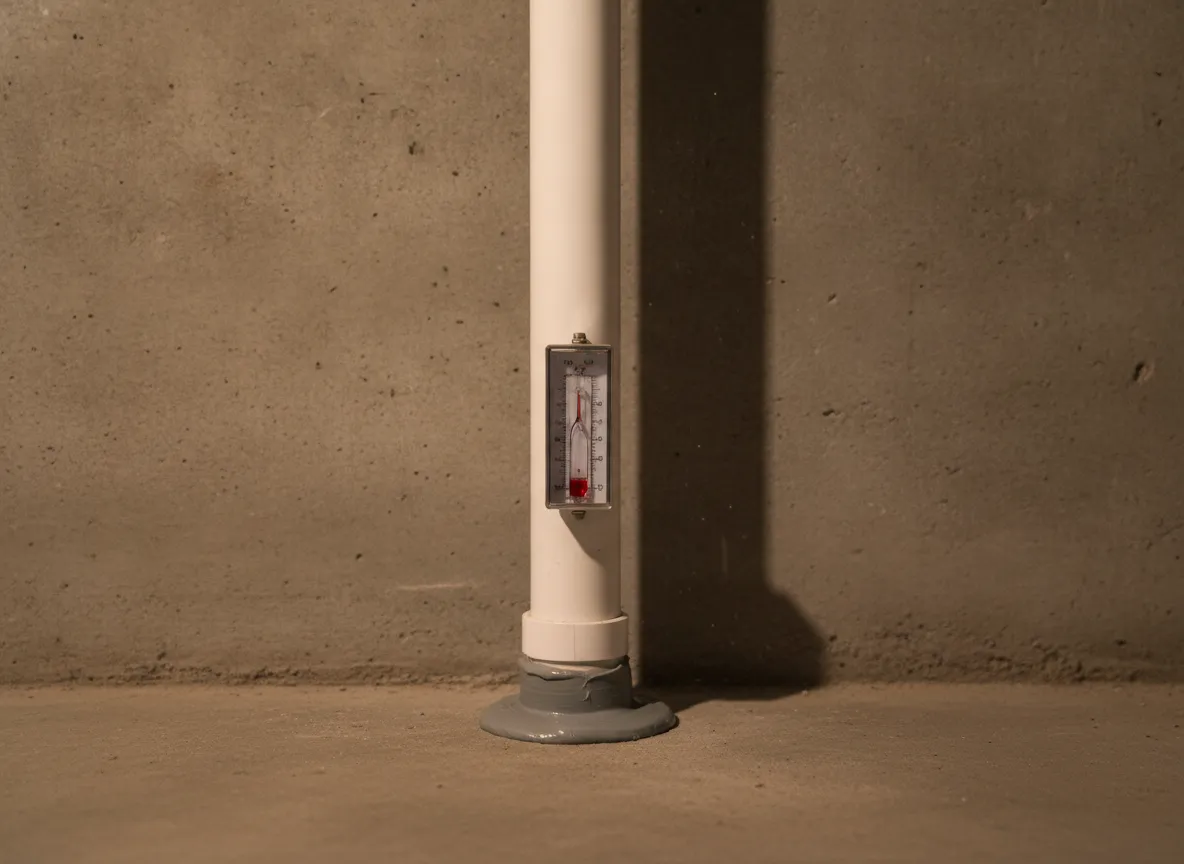
We confirm the pipe runs to the outside and is clear, since a passive outlet can collect leaves or nests (Ontario's home construction regulator flags both). We mount a fan in the space left for it, as close to the exhaust as practical, wire it, fit a manometer, a small liquid gauge that shows the fan is pulling, and label the system as active. A short test starts once the fan has run for a day, and a long-term test goes in for the next heating season (see retesting).
Activation is about $1,500 for a simple one-day job (The Tyee, January 2026), in a newer home with gravel under the slab and the pipe already in place. The Tyee notes the Lungs Matter grant could cover a job like that for eligible households; the grant page explains who qualifies. If the pipe is missing, capped or blocked, the job becomes full radon mitigation and the cost ranges change.
Crawl spaces and houses built before the rule
A crawl space needs a rough-in only if it is conditioned, meaning heated as part of the house, with the air barrier below the ground cover. A vented crawl space with the air barrier under the floor above does not (BC bulletin B24-03).
Houses permitted before March 8, 2024 usually have no pipe unless they fell under the earlier regional rule, so a high result there means a full mitigation system. Send your permit year and test result on the quote form. We reply by email within one business day.
Questions we hear
How do I know if my house has a radon rough-in?
Look in the basement or lowest level for a 100 mm pipe coming up through the slab, labelled as a radon pipe at least every 1.8 m, often a different colour from your plumbing. It should run to the roof or an outside wall, with clear space around one section for a fan. Houses permitted on or after March 8, 2024 should have one under the BC Building Code.
Do I need a fan on my radon rough-in?
Only if a 91-day test in the heating season comes back at or above 200 Bq/m³. The code requires the pipe but not the fan. Health Canada says a passive stack can lower radon by 40 to 90%, which is a wide range, so the test decides. Below 200, leave it passive and retest within five years.
My builder capped the radon pipe in the basement. Is that okay?
Not under the BC code. BC's bulletin B24-03 says a capped-pipe figure in the 2024 code notes was printed in error and the rough-in must extend to the exterior. Ontario allows a capped pipe, which is where much of the confusion comes from. A capped stub can still be extended and fitted with a fan, but it is more work than activating a finished rough-in.
Does the BC code require a radon test in a new house?
No. The bulletin says the code stops applying once construction is complete, so testing is the owner's responsibility after occupancy. Health Canada still recommends a long-term test of at least 91 days during the heating season in any new home with a passive pipe, and the bulletin recommends a three-month test in that season too.
How much does it cost to activate a radon rough-in?
About $1,500 for a simple one-day job (The Tyee, January 2026), meaning a newer home with gravel under the slab and the pipe already in place. A missing, capped or blocked pipe turns it into a full mitigation job, which is typically $1,500 to $4,000 in BC, more for crawl spaces or complex older homes.
Sources (6)
- BC Building and Safety Standards Branch: Bulletin B24-03-R, Radon rough-in requirements (revised January 2025) (accessed 2026-11-17)
- Health Canada: Reduce radon in your home, factsheet (September 2026) (accessed 2026-11-17)
- The Tyee: Homeowners Left on Their Own to Deal with Deadly Gas (January 2026) (accessed 2026-11-17)
- Home Construction Regulatory Authority (Ontario): Radon consumer guide (accessed 2026-11-17)
- Radon mitigation system installation checklist based on CAN/CGSB-149.12 (March 2020) (accessed 2026-11-17)
- Canadian Lung Association: Lungs Matter radon mitigation support (accessed 2026-11-17)